
E, ESL, Hybrid, Cu and HardTop – a box of horseshoe nails can carry several markings together. This guide explains the parts of a nail and what those names mean, helping you understand your farrier’s recommendation and find the right nails for the shoe.
By Team Alutorp · Published 19 November 2026
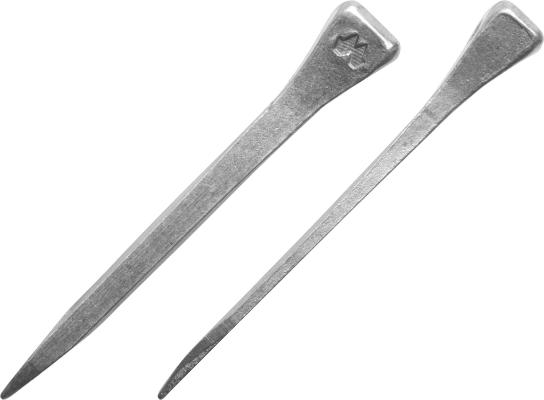
Nail anatomy – from head to point
Horseshoe nails secure the shoe to the hoof wall. The shape of both the head and the slender part of the nail affects how it fits the shoe and hoof.
- Head
- The thicker part that seats in the shoe’s nail hole. Its shape and size must fit the hole and, on a fullered shoe, the fuller as well.
- Neck
- The transition between the head and the shank. Its design varies between nail types.
- Shank or blade
- The long, slender part. Length, width and thickness vary between types and sizes.
- Point and bevel
- The bevel at the point helps guide the nail outwards through the hoof wall. It is part of the point’s shape, not a separate component fitted to the nail.
The nail’s shape does not replace the farrier’s judgement and skill. This guide explains the terminology; it does not describe how to drive nails.
Start with the shoe’s recommended nails
Our horseshoe product pages include recommended nails in the table. Read the row for the relevant shoe size, keeping the nail type and number together. The recommendation helps identify possible combinations; your farrier decides which suits the individual hoof and shoeing job.
An example from our range: The Legend Flat Pony Front with Toe Clip lists Pony / ESL 2 / Hybrid 3.
These are different options for that particular shoe. It does not mean that ESL 2 and Hybrid 3 are the same nail or can always replace each other in other shoes.
If you are reordering from an old box, compare the full designation and brand, not just the number. The same size number can have different lengths and shapes in different nail ranges. Lengths and pack quantities are listed on the individual product pages.
How do E, ESL and Hybrid differ?
E – a common basic type
E is an established nail type available from several manufacturers. Its shank profile differs from the slimmer E-Slim types. You still need to combine the type with the right size and check it against the shoe.
ESL or E-Slim – a slimmer, longer shank
ESL is used as a designation for E-Slim. Mustad describes its E-Slim as having a longer, thinner shank than the corresponding E nail. A slimmer nail is not automatically the right choice for every hoof; the head fit, shank dimensions and hoof conditions all need to suit the application.
Hybrid – a separate nail range from Liberty
Liberty Hybrid has a modified head designed for shoes including concave shoes and shoes with nail holes for E heads. The section just below the head is slightly thicker to provide support in the nail hole. Hybrid is a separate range: a shoe’s recommendations may list it with a different size number from E-Slim, as in the pony example above.
There are also types such as EXL and LX, and nails for particular types of shoe. Mustad’s EXL, for example, has an even longer, thinner shank than E-Slim and a reinforced neck. These names are a reason to check the exact product, not a scale on which a longer or thinner nail is always better.
Secure, HardTop and Road Nail describe different features
Secure in Liberty Hybrid Secure describes a head with more material for its fit in the fuller. HardTop refers to hardening of the head’s upper section, while the rest of the nail retains its original hardness. This is intended to reduce wear on the top of the head.
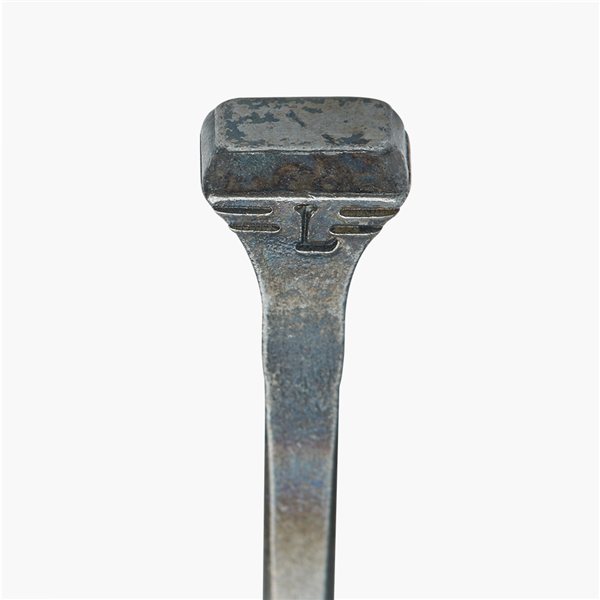
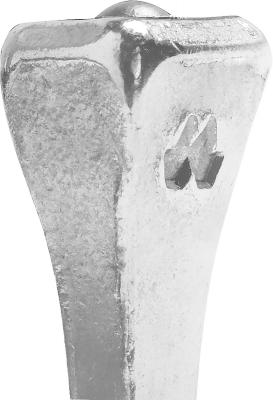
Road Nail and Non-Slip are used for nails with a carbide pin in the head. Mustad describes the Road Nail pin as reducing wear. Kerckhaert also describes increased grip on hard, paved surfaces for Liberty Non-Slip. The underlying nail type and size must still fit the shoe – the words Road and Non-Slip do not make all these nails interchangeable.
The need for grip depends on the surface and the whole shoeing arrangement. Nails with carbide pins do not, by themselves, guarantee protection against slipping.
Cu and Endura – coatings added to a nail type
Cu indicates a copper coating. A Liberty E-Slim Cu is therefore an E-Slim nail with a copper coating; Cu alone does not tell you the nail’s shape or size.
Endura is Mustad’s name for a coating intended, among other things, to increase wear resistance. You still need to read the underlying nail type and size. A surface finish does not replace checking the fit.
Three things to check before ordering
- Shoe and shoe size: read the recommended nails in the correct row of the shoe’s table.
- The full nail designation: brand, type, number and any additions such as Cu, HardTop or Non-Slip.
- The pack: check the number of nails in a box and what a full case contains, where offered. Quantities vary between products and types.
Browse our horseshoe nails, or go directly to Liberty nails, Liberty Cu nails and Mustad nails. For an overview of the shoes themselves, see our guide to choosing horseshoes.
Frequently asked questions about nail markings
Are the bevel and PITCH the same thing?
No. The bevel is at the point. Mustad uses PITCH for an angle between the head and the shank. These are two different aspects of the nail’s design.
Is HardTop the same as Non-Slip?
No. Liberty Hybrid Secure HardTop has a hardened upper section of the head. Liberty Non-Slip has a carbide pin in the head. They are different constructions.
Can two recommended nails have different size numbers?
Yes. Different nail types can fit the same shoe while carrying different size designations. Always read the type and number together. A recommendation for one shoe is not a universal conversion table between nail types.